Saturn Dynamics builds world models for embodied intelligence, generative simulators supporting the entire development life-cycle of embodied intelligence: from training to deployment. We focus on building world models from the ground up in order to make them practical, ensuring they are physically accurate, highly controllable, and efficient at inference time.
What is a world model?
A world model is a learned surrogate of an environment. Given an agent's current observation and action, the world model predicts the state of the environment after the agent's action, often along with signals such as reward or uncertainty (Ha & Schmidhuber, 2018). In reinforcement learning, this interaction is often formalized as a partially observable Markov decision process, where the agent must act from incomplete information (Sutton & Barto, 2018).
The ability to query this surrogate enables more efficient training, planning, and long-tail evaluation (Schrittwieser et al., 2020); (Hafner et al., 2020). For embodied AI, this is especially important: controllers can rehearse and stress-test actions in simulation before executing them in the physical world (Zhao et al., 2020).
A useful world model must generate correct physics, obey the controller's actions, remain causally consistent over time, and support low-latency and cost-efficient inference, since it may be queried millions of times.
World models are moving from research prototypes into production autonomy stacks. Waymo uses its world model to run 20+ billion simulation miles for challenging scenario testing. Waabi runs a closed-loop generative simulation engine to expose its driver to safety-critical edge cases. Wayve GAIA-3 and Nvidia Cosmos provide broader world-model infrastructure for autonomous vehicles and physical AI across training, synthetic data generation, and evaluation.
Toward efficient generative simulators
Recent world models largely inherit the architecture of large-scale video models. As a result, the state of the art covers two categories: creative world models (e.g. Wan, Runway, Luma, Odyssey), which generate photorealistic video from text but are not controllable simulators, and interactive world models (e.g. Nvidia Cosmos, DeepMind Genie 3, Wayve GAIA-3), which introduce control but remain large-scale (10B+), computationally expensive, and limited in action adherence.
| Property | Creative WMs | Interactive WMs | Generative Simulator |
|---|---|---|---|
| Physical fidelity | ✗ | ✗ | ✓ |
| Action controllability | Text | Keypress | Fine-grained |
| Multi-agent simulation | ✗ | ✗ | ✓ |
| Long-horizon consistency | Context-bound | Context-bound | Stateful |
| Throughput | < 30 FPS | ~ 30 FPS | > 60 FPS |
In practice, today’s interactive/video world models remain costly to scale: they often sit around 11B–15B parameters, require 80GB-class or multi-GPU inference, and can take 30–75 seconds to generate only ~5 seconds of video. Meanwhile, embodied AI data remains scarce and low-diversity, limiting generalization to the long tail of physical interactions.
Together, these constraints motivate a ground-up rethink: embodied AI needs generative simulators that are physically grounded, controllable, stateful, multi-agent, and efficient at scale.
Physics- and geometry-grounded learning for World Models
We work in a latent diffusion framework. An autoencoder compresses video into a compact latent space. A generative model produces trajectories in latent space, steered by action injection during generation.
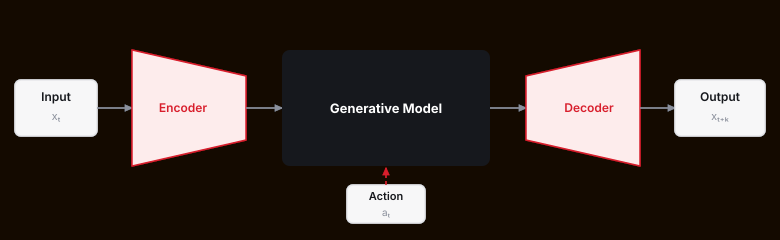
A scientific breakthrough underlines our work. Instead of treating the autoencoder as a compression afterthought, we use it to design a latent space where we distill physical symmetries, with novel approaches inspired by our background in differential geometry and physics.
Our latent space exhibits equivariance to geometric transformation groups, such as SE(3), and semantic clustering. Below, we linearly probe our latent space to uncover shift and rotational equivariance and show that temporally connected states, such as those coming from the same video, are localised in latent space.
Our novel approach to latent design yields a much more diffusable latent space (Skorokhodov et al., 2025). Furthermore, we improve upon standard flow matching training by introducing ideas around manifold learning, differential geometry, and reinforcement learning, for mid- and post-training.
To showcase the efficiency of our approach, we compare the image backbone of our world model against the state of the art of efficient learners in the literature, as reported by (Heek et al., 2026).
We compare the training budget in FLOPs versus the generative Fréchet Inception Distance (gFID) of the resulting model. gFID measures the visual quality of a distribution of generated images/frames against a reference distribution of true images/frames. We require 1000× fewer training FLOPs than state-of-the-art diffusion models to achieve the same performance.
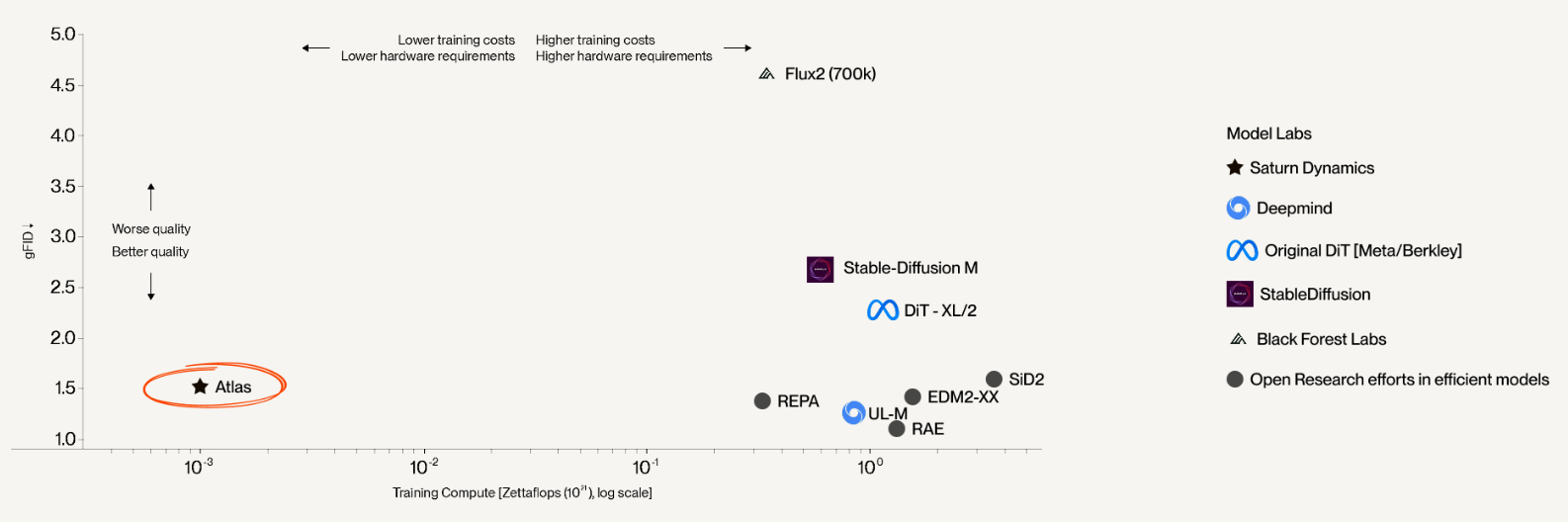
This carries over to our world model, and results is physically and geometrically grounded, highly control-adherent, and inference-friendly world model that we name Atlas.
Atlas
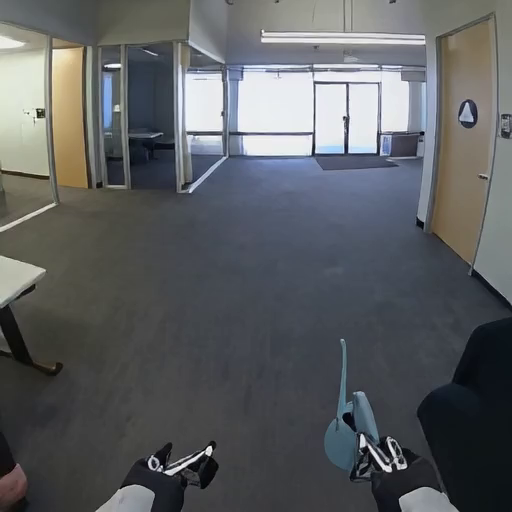
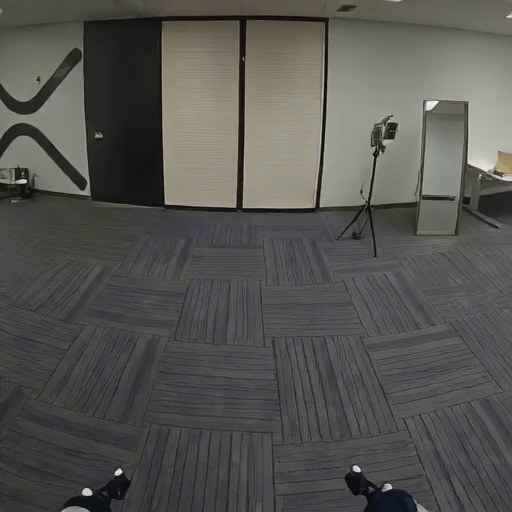
Atlas generates controllable and consistent generative simulations from a single image and a sequence of camera controls. The simulations are physically accurate, preserving motion consistency and real-data velocity distributions; control-adherent, reliably conditioning generation on camera actions.
Zero-shot transfer to extreme scenarios
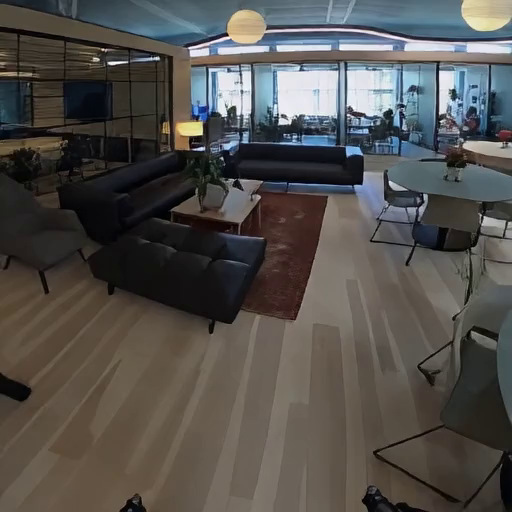
Our focus on geometry-grounded learning also improves our ability to zero-shot complex simulations, like extreme fisheye. This is a challenging scenario for most world models, as data is scarce and the dynamics are non-trivial.
Inference efficiency
Thanks to its compact size and custom inference engine, Atlas achieves 33× higher throughput than its closest comparable model on a single Hopper GPU, while supporting up to 16 parallel simulations.
| Model | Hardware | FPS | Time (5s clip) |
|---|---|---|---|
| Wan 2.2 (14B) | 8×H100 | 0.82 | ~146s |
| Cosmos3-Nano | 1×H100 | 0.91 | ~132s |
| Atlas WM | 1×H100 | 30 | ~4s |
This opens the door to on-device, real-time planning: controllers can evaluate multiple futures locally, update plans at control frequency, and avoid the latency, cost, and reliability limits of cloud-hosted simulation.
Economics of generative simulations
The throughput gap translates into a substantial reduction in marginal simulation cost. At $0.005 per 5-second rollout, Atlas WM enables synthetic data generation, repeated policy evaluation, and long-tail scenario testing at scales that are economically impractical for larger video-world-model baselines.
Relative to comparable systems, this corresponds to roughly 7× lower cost than Cosmos 3 and 220× lower cost than Wan 2.2 per rollout.
| Atlas WM | Nvidia Cosmos 3 | Alibaba Wan 2.2 | |
|---|---|---|---|
| Hardware | 1×H100 | 1×H100 | 8×H100 |
| Cost per 5s | $0.005 | $0.037 | ~$1.10 |
| Cost per second | $0.001 | $0.007 | ~$0.22 |
| Cost per frame | $0.000047 | $0.00035 | ~$0.010 |
Results & Benchmarks
Atlas Autoencoder (Atlas AE)
Atlas Autoencoder (Atlas AE) is under 100M parameters with 4×16×16 compression, yet sets a new state of the art on both public (Kinetics-600, LAVIB) and harder internal benchmarks.
It reconstructs motion more faithfully and preserves geometry, even in extreme cases such as the fisheye sample below. Our tokenisation roundtrip sits at <10ms, and Atlas AE runs in real time at 30 FPS+ on a single RTX GPU.
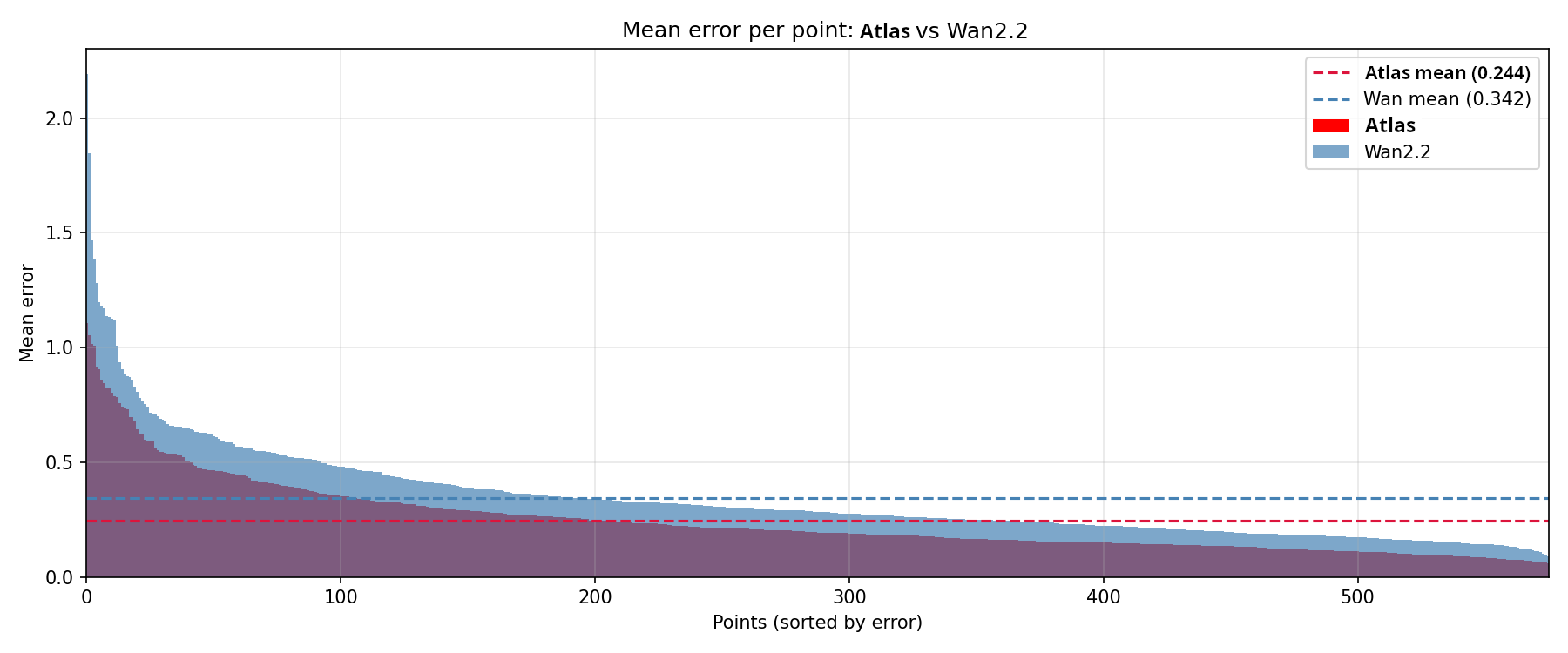
Our efforts in distilling semantics into the latent space yield a latent manifold with semantic structure that is, importantly, stable over time. This, together with the geometric grounding shown above, simplifies the generative learning task by effectively building simple-to-learn equivalences between latent trajectories.
Atlas World Model (Atlas WM)
Atlas WM is under 2B parameters, yet outperforms comparably sized models and matches the 14B SOTA (Wan 2.2) at a fraction of the size.
| Model | gFID ↓ | gFVD ↓ | DINOFD ↓ | CoTrackerFVMD ↓ |
|---|---|---|---|---|
| Wan 2.2 (14B) | 3.9 | 32.4 | 23.8 | 1009 |
| Wan 2.1 1.3B (distilled) | 61.5 | 746.1 | 823.7 | 3042 |
| Atlas WM | 1.7 | 8.4 | 35.6 | 355 |
More importantly, Atlas WM not only generates better video, its learned dynamics also transfer to embodied data. We evaluate Atlas zero-shot on DROID (Khazatsky et al., 2024) and DROID-OOD (a collection of in-the-wild manipulation data), see WEAVER (Jain et al., 2026).
| Model | DROID (val) | DROID (OOD) | ||
|---|---|---|---|---|
| gFID ↓ | gFVD ↓ | gFID ↓ | gFVD ↓ | |
| Ctrl-World | 25.32 | 91.77 | 33.47 | 145.86 |
| WEAVER | 16.75 | 66.89 | 27.37 | 145.04 |
| Cosmos3-Nano (16B) | 19.08 | 73.10 | 85.74 | 240.75 |
| Cosmos3-Edge (4B) | 28.82 | 127.30 | 109.66 | 307.82 |
| Atlas WM | 13.52 | 54.41 | 17.33 | 82.42 |
Gallery of Atlas generated samples on DROID,
To help visualise the trajectory difference between the world model and the ground truth, below we provide a handful of videos where we overlay the edges of the ground truth video on top of the Atlas generation.
Next steps: the Atlas Learning Environment (Q4 2026)
We are actively developing the next generation of Atlas, with longer-horizon generation at constant inference time, text-conditioned generation, multi-camera support, and off-the-shelf adapters for VLAs, such as GR00T and π.
The latest version of Atlas WM is already in the hands of design partners, who are using it to enhance datasets, evaluate control policies, and, together with leading researchers, explore real-time planning.
Furthermore, while Atlas is the central piece of the Saturn Dynamics ecosystem, we are also developing the Atlas Learning Environment (ALE), a full-stack generative simulator for embodied AI. ALE will serve as the SDK to interact with Atlas, providing a one-stop solution for embodied AI development, including:
- Observability of the environment state through the world model, enabling stress-testing of the controller's behaviour and failure replay.
- Interoperability with classical simulators for hybrid simulation, allowing us to combine the best of both worlds: physics-based and data-driven simulation.
- Evaluation of navigation and manipulation tasks in a generative simulator.
- Synthetic data generation at scale for training and evaluation of embodied AI controllers.
Appendix: Metrics
Peak Signal-to-Noise Ratio (PSNR). Measures the pixel noise between two images. It is often used as a metric to measure the quality of compression between a reference image and its reconstructed counterpart.
Fréchet Inception Distance (FID). Measures the distance in feature space between true images and generated images. The features are extracted by using Inception as a feature extractor. This was historically considered to align well with human perception. Heusel et al., 2017
DINO Fréchet Distance (DINOFD). An extension of the above that uses DINOv2 as a feature extractor instead of Inception. We found this to be a better gauge of quality and alignment with human perception.
Fréchet Video Distance (FVD). A historical extension of FID to videos. We retain it as it is broadly reported. Unterthiner et al., 2019
CoTracker Fréchet Video Motion Distance (CoTrackerFVMD). Our generalisation of FVMD using CoTracker point tracking as an estimator of motion levels and motion consistency. We find this metric to be extremely useful to validate the quality of motion at scale.